Get test_aoi_and_aoi_projection passing on numpy 1.22.0#1369
Conversation


 kandersolar
changed the title
kandersolar
changed the title

|
all pytests passed using that environment variable, so I'll switch to loosening the test tolerance. |

|
Wow, nice work. Do you see a change in https://pvlib-benchmarker.github.io/pvlib-benchmarks/#irradiance.Irradiance.time_aoi_projection ? That test might not use enough data points to get over the python overhead. Just noticed that 5bdad644 slowed it down by more than I would have expected. |

I concur. The case that is failing is zenith=tilt=30, and solar_azimuth=system_azimuth=180, which should return AOI=0 but returns AOI ~ 1.2e-6. Close enough to zero for any use case I can think of. |
|
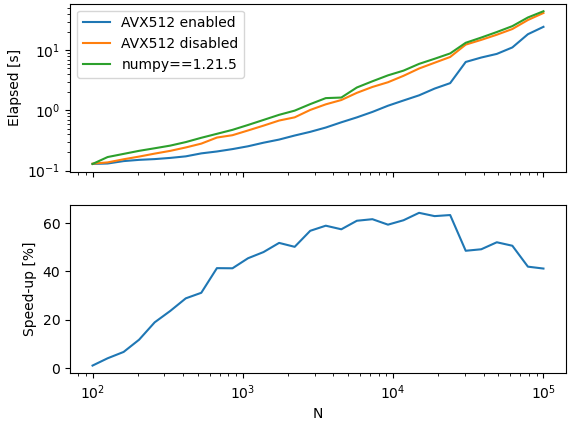
It can apparently be quite a significant speed improvement for numpy-heavy functions. Here is a small comparison for Click to expandimport numpy as np
import pvlib
import timeit
data = []
for N in np.logspace(2, 5, 30).astype(int):
surface_tilt = np.random.random(N)
surface_azimuth = np.random.random(N)
solar_zenith = np.random.random(N)
solar_azimuth = np.random.random(N)
dt = timeit.timeit(lambda: pvlib.irradiance.aoi(surface_tilt, surface_azimuth, solar_zenith, solar_azimuth), number=5000)
data.append({'N': N, 'elapsed': dt})
print(data)
As for the ASV results -- I keep managing to fix a problem on the server without actually fixing it, so the current published timings are a bit out of date. I think none of them are new enough to have used numpy 1.22.0 so I wouldn't expect to see a speed-up in those plots yet. |

| aoi = irradiance.aoi(surface_tilt, surface_azimuth, solar_zenith, | ||
| solar_azimuth) | ||
| assert_allclose(aoi, aoi_expected, atol=1e-6) | ||
| assert_allclose(aoi, aoi_expected, atol=1e-5) |
There was a problem hiding this comment.
@cwhanse any objection to just bumping this tolerance to 1e-5?

|
Ok, proposed fix seems uncontroversial so I'll go ahead and merge. It's nice that such a sweeping change (numpy returning slightly different answers) ended up breaking only one test. Also I had another thought: the ASV runs are done in conda envs, which means we might not see the new numpy there for some time. No clue what the update cadence is on conda. |

3 participants


[ ] Closes #xxxx[ ] Tests added[ ] Updates entries todocs/sphinx/source/api.rstfor API changes.[ ] Adds description and name entries in the appropriate "what's new" file indocs/sphinx/source/whatsnewfor all changes. Includes link to the GitHub Issue with:issue:`num`or this Pull Request with:pull:`num`. Includes contributor name and/or GitHub username (link with:ghuser:`user`).[ ] New code is fully documented. Includes numpydoc compliant docstrings, examples, and comments where necessary.A test recently started failing because a returned value was very slightly different from the expected value (example):
In here #717 (comment) I speculated that this was because of a change in numpy 1.22.0 enabling a set of SIMD extensions (AVX512), which can improve calculation speed but can also result in very slightly different calculation results. Here are the reasons I think it's the source of this test failure:
NPY_DISABLE_CPU_FEATURES="AVX512F,AVX512CD,AVX512VL,AVX512BW,AVX512DQ,AVX512_SKX"So I'm trying that same environment variable in our CI configuration to see if that resolves the CI failure as well. If so I think we can be pretty confident that this numpy change is responsible.
As a permanent fix, I think we should just loosen the tolerance on the failing test a bit.