
A Kandev plugin that shows the current session's spend, cost per turn, and per-model usage in the chat composer. The backend reads the local agent transcript through the tokscale CLI.
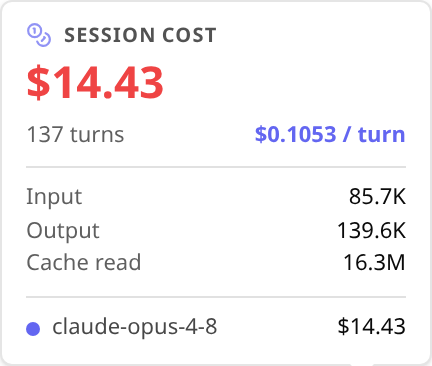
Session cost details on hover or focus, with the total, cost per turn, token totals, and per-model breakdown:
The action appears in the chat composer toolbar:

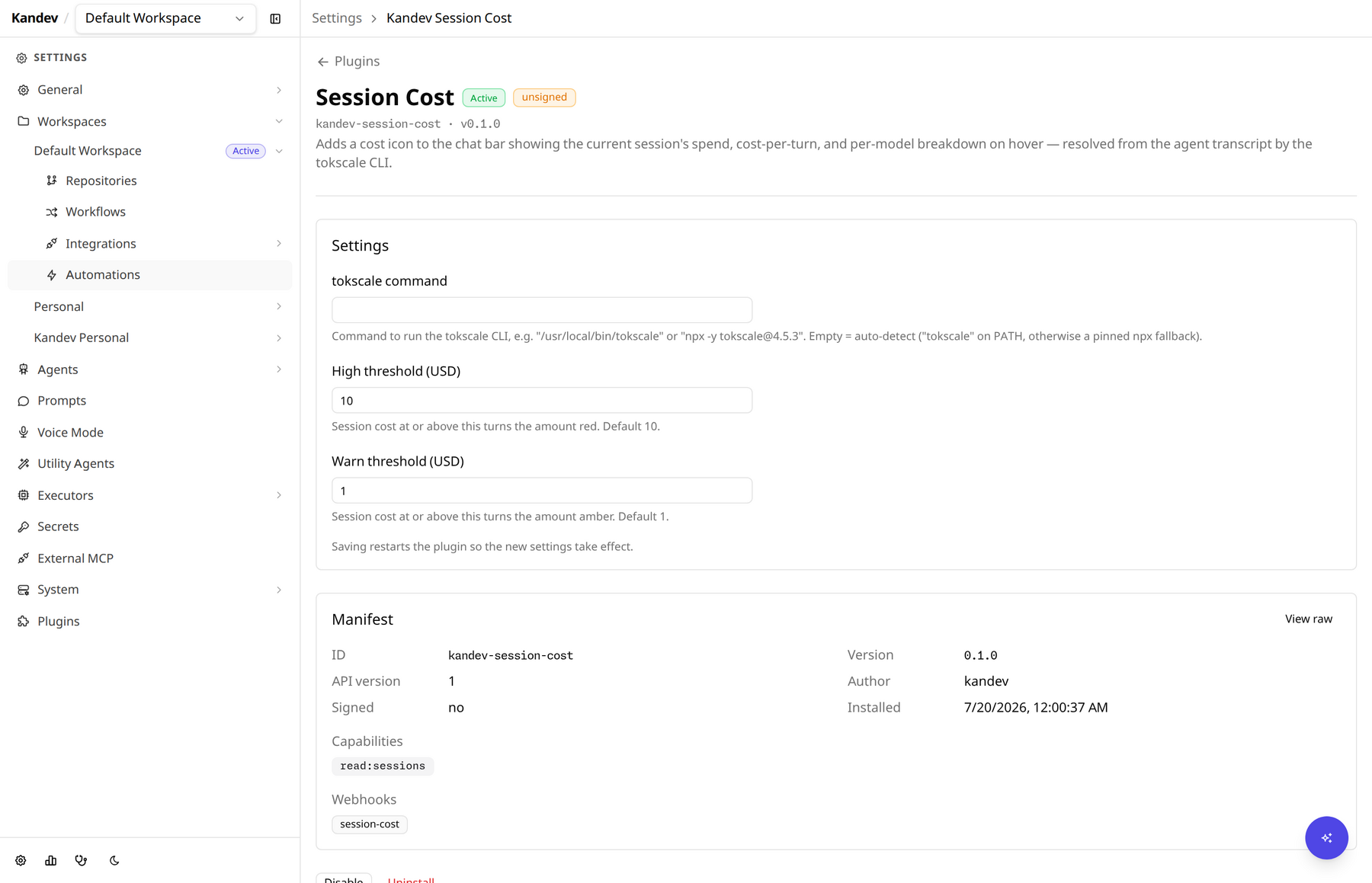
Settings are generated from manifest.yaml:
- The action registers once in
chat-input-actions. Hover or keyboard focus starts one request for the active session. Click or tap pins the details open. - The accessible action label stays “Session cost” when the displayed amount
changes. On hosts with
host.ui.Action, the host owns the action's size, spacing, focus style, and icon box. Hosts without Action use the plugin's existing Button fallback. - Pinned details show the total, cost per turn, input/output/cache-read token totals, and per-model costs and token counts. Click or tap the action again, click outside, or press Escape to close them.
- Refresh is available while details are pinned. It recalculates the active session once and remains disabled until the request finishes.
- The backend uses one report worker for all sessions. A new lookup returns a progress state while tokscale scans transcripts. The backend keeps the last successful report in memory for 30 seconds.
- While a report runs, details keep the last successful cost and mark it as a previous result. A report or request error shows translated recovery text and a retry action.
- The browser requests status every two seconds while details stay open. It stops polling after 130 seconds. Each request has a 10-second timeout.
- The backend stops its report worker and child processes when the plugin stops. It does not start a report when the active session has no ACP transcript.
- The total changes from green to amber at
warn_thresholdand to red athigh_threshold. - The backend maps the Kandev session ID to the agent transcript ID. The UI sends only Kandev task and session IDs.
- If tokscale is unavailable, the details explain how to configure its command.
The action label and details are registered with Kandev's plugin translation API. English is the fallback; Portuguese (Portugal) is also included.
The manifest uses plugin API v1 and requests read-only access to Kandev
sessions (api_read: ["sessions"]). It does not request credentials or write
access. The plugin runs tokscale on the machine hosting the Kandev plugin
backend, so tokscale must be installed there or available through the configured
command.
The package contains server binaries for Linux amd64 and arm64, macOS amd64 and arm64, and Windows amd64. The UI uses the host's React instance and does not bundle a second React runtime.
The Go and frontend SDK source pin is
570600439036e81f8e9e1c63f15c4abce8a6c846, which includes host PR #3943 and
host.ui.Action. This is a source revision, not a Kandev release number. The
UI detects Action and retains the Button path for older hosts. The manifest
does not declare a minimum Kandev version. Packaged UI checks passed against
Kandev v0.97.0 and the older v0.86.0 reference; these tested versions do not
establish a declared support floor.
Open Settings → Plugins → Session Cost:
commandsets the tokscale command or path. Empty usestokscalefrom PATH, then the pinnednpx -y tokscale@4.15.1fallback.warn_thresholdis the USD amount at which the displayed total turns amber. Its default is 1.high_thresholdis the USD amount at which the displayed total turns red. Its default is 10.
Download the package from a GitHub Release and upload it in Settings → Plugins → Install plugin. You can also install the local package through the plugin API:
curl -F package=@kandev-session-cost-0.4.1.tar.gz http://localhost:8080/api/plugins/installUse Go 1.26 and Node.js 24. The Go module resolves the unpublished Kandev SDK
from a sibling checkout at ../kandev/apps/backend. Create a private checkout
for this plugin worktree and pin it to the source revision above:
git clone --filter=blob:none https://github.com/kdlbs/kandev.git ../kandev
git -C ../kandev checkout --detach 570600439036e81f8e9e1c63f15c4abce8a6c846
Do not point the module replacement at a floating branch. The host checkout is outside the plugin tree and can be shared by Go builds, package checks, and the disposable host smoke test.
Run the local checks from the plugin root:
make check-format
go mod tidy
git diff --exit-code -- go.mod go.sum
make vet
make test
make build
make package-host
make package
make verify-package-host
make verify-package
make test runs the Go suite, UI bundle behavior tests, JavaScript syntax
check, and negative package/release verifier tests. make verify-package-host
checks the package for the current machine. make verify-package builds and
checks all five declared platforms, the UI bundle, manifest identity, exact
file inventory, and checksums. make package-host and make package create
the corresponding archives without the additional verification step.
The UI has no build step or npm dependencies. The UI bundle unit tests use mocked fetch responses. They do not run tokscale or read an agent database.
Build the disposable Kandev host and its E2E fixture package:
PLUGIN_ROOT=$PWD
HOST_ROOT=$PLUGIN_ROOT/../kandev
(cd "$HOST_ROOT" && make build-backend build-web-e2e build-e2e-plugin-package)
(cd "$HOST_ROOT/apps" && pnpm install --frozen-lockfile)
Run both desktop and phone checks against the package.
The tests install the archive through the host UI. Each test uses a temporary tokscale command. The command blocks, returns fixture data, and fails once. The browser calls the installed webhook and checks its recovery states.
(cd "$HOST_ROOT/apps/web" && \
  NODE_OPTIONS='--import=tsx' \
  SESSION_COST_PACKAGE_PATH="$PLUGIN_ROOT/kandev-session-cost-0.4.1.tar.gz" \
  SESSION_COST_EXPECT_ACTION=1 \
  pnpm exec playwright test --config "$PLUGIN_ROOT/test/host-action-smoke.playwright.config.mjs")
For an older host checkout, set KANDEV_HOST_ROOT to its path and set
SESSION_COST_EXPECT_ACTION=0. Build that host with the same commands first.
The checked fallback reference is Kandev v0.86.0.
The stable release check also uses this same package against Kandev v0.97.0
(release, source commit
e43881c7555372897b57ec51c705f1e05da43c40). Verify the published Linux x64
full-runtime archive with its .sha256 file. Set PLUGIN_ROOT to this
checkout, HOST_ROOT to a source checkout at that exact commit, TASK_TMP to
a short task-owned temporary directory, and E2E_RUNTIME to a subdirectory of
TASK_TMP. Build the release source's E2E web assets and mock-agent fixture
(pnpm install --frozen-lockfile, make build-web-e2e, and
make -C apps/backend build-mock-agent). agentctl looks for mock-agent
beside the runtime executable, so copy the verified runtime to a disposable
directory and add that fixture beside it; do not modify the downloaded
release archive. For example:
mkdir -p "$TASK_TMP" "$E2E_RUNTIME"
tar -xzf /path/to/kandev-linux-x64-full.tar.gz -C "$TASK_TMP"
cp -a "$TASK_TMP/kandev/." "$E2E_RUNTIME/"
cp "$HOST_ROOT/apps/backend/bin/mock-agent" "$E2E_RUNTIME/bin/mock-agent"
chmod +x "$E2E_RUNTIME/bin/mock-agent"
Set KANDEV_E2E_BIN to $E2E_RUNTIME/bin/kandev and KANDEV_HOST_ROOT to
$HOST_ROOT. Put $E2E_RUNTIME/bin first on PATH. Use isolated HOME, XDG
data/config/cache directories, TMPDIR, and Playwright port offsets, and run
the two projects separately with --workers=1:
mkdir -p "$TASK_TMP/home" "$TASK_TMP/config" "$TASK_TMP/data" \
  "$TASK_TMP/cache" "$TASK_TMP/tmp" "$TASK_TMP/artifacts"

env HOME="$TASK_TMP/home" XDG_CONFIG_HOME="$TASK_TMP/config" \
  XDG_DATA_HOME="$TASK_TMP/data" XDG_CACHE_HOME="$TASK_TMP/cache" \
  TMPDIR="$TASK_TMP/tmp" PATH="$E2E_RUNTIME/bin:$PATH" \
  NODE_OPTIONS='--import=tsx' KANDEV_HOST_ROOT="$HOST_ROOT" \
  KANDEV_E2E_BIN="$E2E_RUNTIME/bin/kandev" \
  SESSION_COST_SMOKE_ARTIFACT_DIR="$TASK_TMP/artifacts" \
  SESSION_COST_PACKAGE_PATH="$PLUGIN_ROOT/kandev-session-cost-0.4.1.tar.gz" \
  SESSION_COST_EXPECT_ACTION=1 E2E_PORT_OFFSET=22 \
  pnpm exec playwright test --config "$PLUGIN_ROOT/test/host-action-smoke.playwright.config.mjs" \
    --project=chromium --workers=1 --retries=0

# Repeat with E2E_PORT_OFFSET=23 and --project=mobile-chrome.
Each successful run attaches and saves a task-composer screenshot under
$TASK_TMP/artifacts.
Pull requests check module tidiness, Go formatting, vet, Go and UI tests, and
both host-only and full platform packages. CI, package builds, and releases
read the same immutable SDK source pin from .kandev-sdk-ref. Node is set up
explicitly for the UI tests.
Release automation runs from main. Select a patch, minor, or major bump, then
use its dry run before a release. The workflow builds and validates the proposed
version before it pushes release metadata or a tag. A pushed tag must match the
manifest, Makefile, and packaged manifest before the workflow publishes a
GitHub Release with the archive and checksums.txt.
The stable-host validation condition for this package is met on Kandev v0.97.0,
which includes PR #3943. Keep the package parked in its draft PR until the
maintainer authorizes merge and the remaining overlapping plugin work is
reconciled.
See LICENSE.