
An integration of backtest-kit that replaces the default file-based
./dump/persistence with MinIO (S3) as the source of truth and Redis as a time-ordered index, packaged withdocker-composefor one-command deploys.
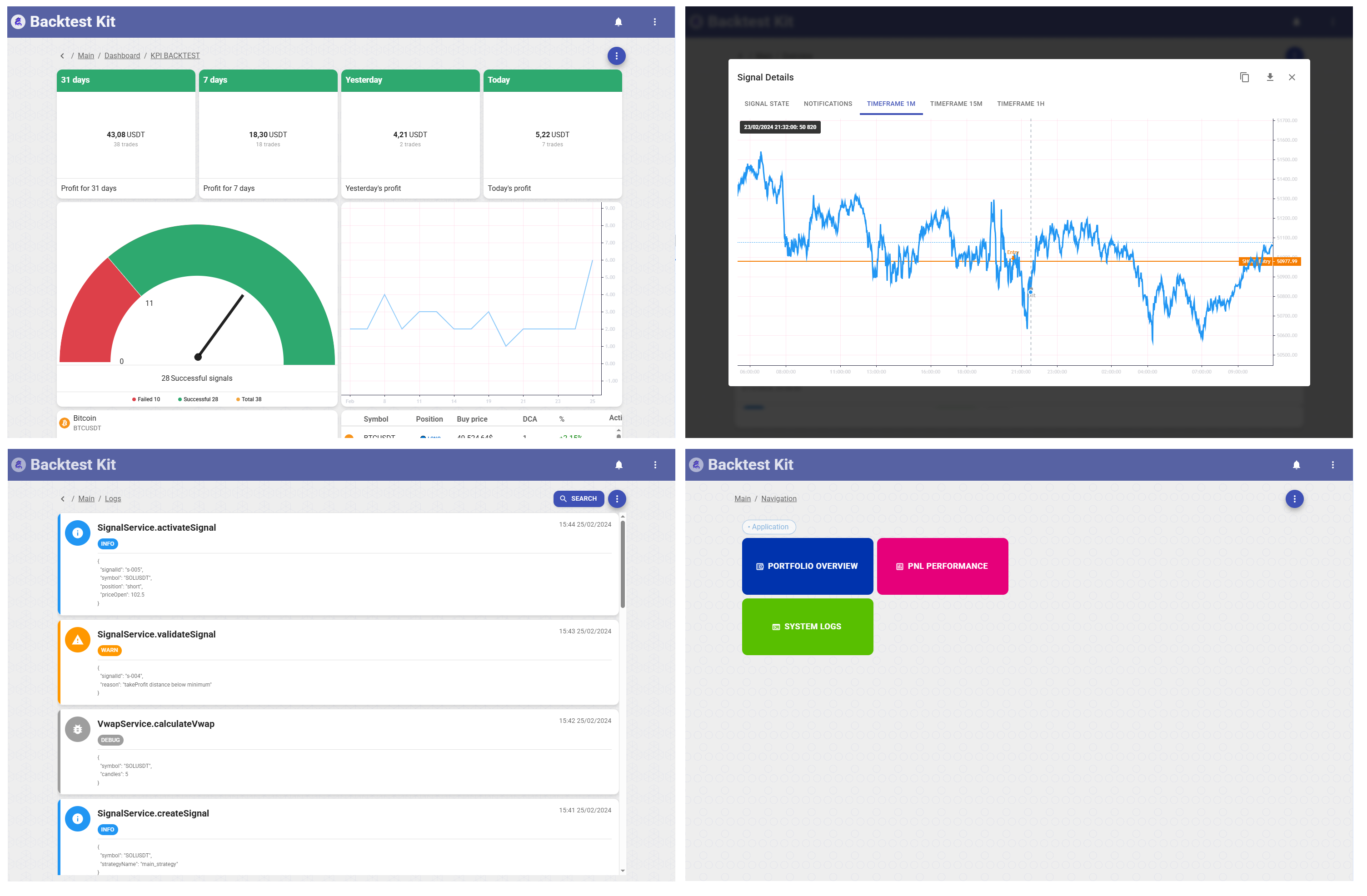




This project ships 16 custom Persist adapters that implement the full backtest-kit IPersist*Instance contract on top of MinIO + Redis. Strategy code, runners, and the CLI entrypoint stay unchanged — only the persistence layer is swapped.
An exotic but deliberate middle ground between the built-in file adapter and a full database:
Default file ./dump/ |
MinIO + Redis (this project) | @backtest-kit/mongo / @backtest-kit/pg |
|
|---|---|---|---|
| Infrastructure | none | 2 containers | database + Redis cache |
| Source of truth | JSON files on local disk | JSON objects in S3 bucket | rows / documents |
| Durability & ops | single host, manual backup | S3 semantics: versioning, replication, mc mirror, lifecycle |
DB tooling: dumps, replicas |
| Newest-first listings | directory scan | Redis minute-index, O(limit) | ORDER BY … LIMIT, O(log n) |
| Point reads (candles) | fs.readFile |
1 GET ≈ 1–3 ms | b-tree lookup ≈ 0.1–1 ms |
| Sweet spot | local runs, CI | fat JSON snapshots, cheap unbounded archive, S3-native infra | hundreds of millions of candles, ad-hoc SQL/aggregation |
Pick this variant when you want S3-grade durability and zero schema management, but a full DBMS would be overkill. If your candle set grows into the hundreds of millions, take the pg/mongo package instead — b-trees win that workload.
📚 API Reference | 🌟 Quick Start | 📰 Article
Start MinIO and Redis in containers:
docker-compose -f docker/minio/docker-compose.yaml up -d
docker-compose -f docker/redis/docker-compose.yaml up -d
Run a backtest:
npm run start -- --entry --backtest --ui ./build/index.cjsLive mode:
npm run start -- --entry --live --ui ./build/index.cjsPaper mode:
npm run start -- --entry --paper --ui ./build/index.cjsBundles the strategy, runner, and backtest-kit container together. Reads MODE from env (backtest | live | paper):
MODE=backtest ENTRY=1 UI=1 STRATEGY_FILE=./build/index.cjs docker-compose up -d
docker-compose logs -f
Or via npm script:
npm run start:docker
npm run stop:dockerEach adapter implements the corresponding IPersist*Instance interface from backtest-kit and is registered in src/config/setup.ts. All adapters share the same skeleton:
PersistXAdapter.usePersistXAdapter(class implements IPersistXInstance {
  constructor(/* context fields from backtest-kit */) {}
  async waitForInit(initial: boolean) {
    if (!initial) return;
    await waitForInfra();        // gate first-touch on Redis ready (MinIO client is lazy)
  }
  async readXData(...) { return await ioc.xDataService.findByContext(...); }
  async writeXData(..., when: Date) { await ioc.xDataService.upsert(..., when); }
});
Everything lives in one MinIO bucket backtest-kit — each entity gets a root folder. The BaseStorage("backtest-kit/<entity>-items") name format is parsed as bucket/parent-folder: the first path segment is the physical bucket, the rest becomes a transparent key prefix (src/lib/common/BaseStorage.ts). A name without a slash (BaseStorage("breakeven-items")) still means a dedicated bucket — fully backward compatible.
| Adapter | Folder | Object key | Purpose |
|---|---|---|---|
| Candle | candle-items/ |
exchange/symbol/interval/timestamp |
OHLCV cache; immutable inserts |
| Signal | signal-items/ |
symbol/strategy/exchange |
Live signal state per context |
| Schedule | schedule-items/ |
symbol/strategy/exchange |
Pending scheduled signal |
| Strategy | strategy-items/ |
symbol/strategy/exchange |
Deferred commit queue snapshot |
| Risk | risk-items/ |
riskName/exchange |
Active risk positions snapshot |
| Partial | partial-items/ |
symbol/strategy/exchange/signalId |
Partial profit/loss levels per signal |
| Breakeven | breakeven-items/ |
symbol/strategy/exchange/signalId |
Breakeven reached flag |
| Storage | storage-items/ |
backtest/signalId |
Closed/opened signal log per mode † |
| Notification | notification-items/ |
backtest/⟲ts_notificationId |
Event notifications † |
| Log | log-items/ |
⟲ts_entryId |
Strategy log entries † |
| Measure | measure-items/ |
bucket/entryKey |
LLM/API response cache |
| Interval | interval-items/ |
bucket/entryKey |
Once-per-interval markers |
| Memory | memory-items/ |
signalId/bucket/memoryId |
Per-signal memory store |
| Recent | recent-items/ |
symbol/strategy/exchange/frame/backtest |
Last public signal per context |
| State | state-items/ |
signalId/bucket |
Per-signal state buckets |
| Session | session-items/ |
strategy/exchange/frame/symbol/backtest |
One session per running strategy |
⟲ts = inverted timestamp (MAX_SAFE_INTEGER − ms, zero-padded): plain lexicographic S3 listing yields newest first with no sorting. † = entity also maintained in the Redis time index (see below).
backtest-kit has a write durability contract: after writeXData(...) returns, the very next readXData(...) must see the just-written value. S3 gives strong read-after-write consistency for single objects, so the contract holds with plain object semantics — no transactions needed:
- Deterministic keys. Every record's object key is a pure function of its context (
symbol/strategy/exchange/…), so an upsert is a single idempotentPUT— no read-before-write, no duplicate-key races. - Immutable entities never rewrite. Candles use a
stat+PUTinsert-only pair; log entries and notifications skip thePUTentirely when the key already exists, backed by an in-process index of persisted keys (FIFO-capped) so re-sending the accumulated list costs zero network in steady state. - Write order: MinIO first, Redis second. A crash between the two leaves an object readable by key but invisible to listings — never a phantom entry pointing at nothing.
removedmeans absent. Soft-delete entities (Measure, Interval, Memory) physically delete the object instead of writing a tombstone.listKeysis then a pure prefix LIST — zero body reads — and reads of removed entries returnnullby construction.
// src/lib/services/data/CandleDataService.ts — insert-only, one stat + one PUT
public create = async (dto: ICandleDto): Promise<ICandleRow> => {
  const key = GET_STORAGE_KEY_FN(dto.symbol, dto.interval, dto.timestamp);
  const row: ICandleRow = { id: key, ...dto, /* dates */ };
  if (await this.has(key)) return row;   // candles are immutable — no body download
  await this.set(key, row);
  return row;
};S3 can list keys only in lexicographic order and cannot answer "what was created last" without walking the bucket. For the three entities that need newest-first listings (Log, Notification, Storage), a *ConnectionService (src/lib/services/connection/) maintains a Redis index:
- One Redis SET per minute:
<entity>-connection:<aligned-minute>→ object names.register()is a single pipeline (SADD+SETNXof the floor marker). Timestamps are minute-aligned viaalignToInterval, so re-registering within a minute deduplicates by construction. listNewest(limit, prefix)walks backwards from the current minute — direct key lookups, noSCANover the keyspace. Minutes are probed in pipelines of 1000; a cheapSCARDpass skips empty minutes without transferring a single member; hot minutes (a fast backtest replay packs many records into one wall-clock minute) are paged viaSSCANwith early exit atlimit.- Cold-index fallback. If Redis was flushed, listings fall back to the bucket LIST (inverted-timestamp keys are already newest-first) and warm the index back up.
Steady-state cost of readLogData at startup: 1 RTT for the floor + 1–2 pipeline RTTs + ≤200 point GETs for bodies — independent of how many objects the bucket holds.
// src/lib/services/data/LogDataService.ts — read path
const names = await this.logConnectionService.listNewest(LIST_LIMIT);
if (names.length) {
  for (const name of names) rows.push(await this.get<ILogRow>(name));
} else {
  for await (const value of this.values("", LIST_LIMIT)) { /* fallback + re-warm */ }
}docker/
minio/docker-compose.yaml # MinIO on :9000 (S3) / :9001 (console), volume ./minio_data
redis/docker-compose.yaml # redis:7.4.1 on :6379, password=mysecurepassword
docker-compose.yaml # main: backtest-kit container, mounts project as /workspace
The main docker-compose.yaml uses extra_hosts: host.docker.internal:host-gateway so the container reaches MinIO and Redis on the host machine. Use host.docker.internal instead of 127.0.0.1, or override via .env if your infrastructure runs elsewhere:
CC_MINIO_ENDPOINT=prod-minio
CC_MINIO_PORT=9000
CC_MINIO_ACCESSKEY=...
CC_MINIO_SECRETKEY=...
CC_REDIS_HOST=prod-redis
CC_REDIS_PORT=6379
CC_REDIS_USER=default
CC_REDIS_PASSWORD=...
Container env vars consumed by @backtest-kit/cli:
| Var | Purpose |
|---|---|
MODE |
backtest | live | paper |
STRATEGY_FILE |
Path to compiled strategy bundle (default: ./build/index.cjs) |
ENTRY |
Set to 1 to actually run (matches --entry flag in CLI mode) |
SYMBOL, STRATEGY, EXCHANGE, FRAME |
Override strategy context |
UI |
Enable web UI on :60050 |
TELEGRAM, VERBOSE, NO_CACHE, NO_FLUSH |
Standard backtest-kit CLI flags |
Healthcheck pings http://localhost:60050/api/v1/health/health_check every 30s.
The actual trading logic lives outside the persistence layer — see src/logic/strategy/ and src/logic/frame/ for examples, and modules/ for the ccxt exchange adapter registration. Mode-specific entry points in src/main/ gate on CLI args from src/helpers/getArgs.ts:
// src/main/backtest.ts
const main = async () => {
  const { values } = getArgs();
  if (!values.entry || !values.backtest) return;

  await ioc.redisService.waitForInit();   // MinIO client connects lazily per bucket
  await waitForReady(true);

  await warmCandles({ exchangeName: ExchangeName.CCXT, /* ... */ });

  Backtest.background("TRXUSDT", {
    exchangeName: ExchangeName.CCXT,
    frameName: FrameName.Jan2026Frame,
    strategyName: StrategyName.Jan2026Strategy,
  });
};