

Open tools for guitarists, and open research in holographic computing. A strobe tuner reads a string by watching the phase of each harmonic drift. A hologram stores data as unit phasors whose phases add. Squatch Stack follows that one idea in two directions, in the open, and measures before it claims.
A software strobe that reads a string to a tenth of a cent. Free, MIT, and the core is one folder of C++ headers, also the first block of squatch-dsp.
| Repository | What it does |
|---|---|
| squatch-tuner C++17 · MIT |
A guitar and bass tuner built as a software strobe. Header-only, no dependencies, and it never allocates or locks in the audio path. It runs in the browser and on a Raspberry Pi, and is written for microcontrollers too. Re-pitch real guitar DI by exactly 7 cents and it measures the shift with a median error of 0.005 c and a 95th percentile of 0.13 c (MPM: 0.041 and 0.25). make results reproduces every number. |
| squatch-dsp C++17 · MIT |
The open C++ sound engine that Squatch tools share. Each block is written once and each target gets a thin host: today JACK on a Raspberry Pi and WebAssembly in the browser. The tuner is its first block, alongside a lookahead limiter, a gate and an EQ. Its tests prove that no block allocates or locks in the audio path, and check each block against a reference render. |
| NeuralAmpModelerCore fork · C++ · MIT |
Neural Amp Modeler is the open way guitarists capture amps and pedals. Our fork of its C++ core, for running NAM well on small hardware like the Raspberry Pi 5. |

| Repository | What it does |
|---|---|
| hdc-holo Python · Apache-2.0 · pip install hdc-holo |
Data structures, Gaussian-splat scenes, learning, rendering and CRDT sync, superposed in complex FHRR hypervectors. A lookup is an inner product, and capacity is a signal-to-noise budget. v0.3.0 is on PyPI, with a Zenodo DOI. |
| posekit Swift · Apache-2.0 |
Camera poses from Apple's photogrammetry, for splat trainers. It writes nerfstudio and COLMAP formats on Apple silicon, with no CUDA. |
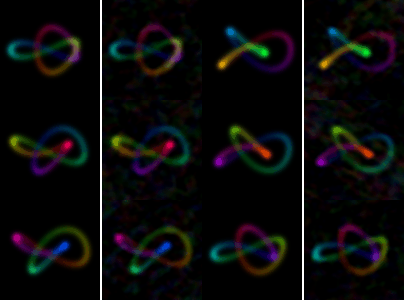
A whole colored 3-D scene orbited from one 768 KB complex vector.
No geometry exists at render time.
- Measured, not claimed. Every technique ships with its capacity law, ground-truth figures, deterministic tests and the negative results.
- Honest about the limits. As a storage format, a hologram is about 400× larger than SPZ, and the README says so before anything else.
- Collaborative by algebra. CRDT sync over Loro: two processes co-paint one scene over TCP and converge bit-for-bit.

Everything here is free and open source. Sponsorship buys the two things open work runs short of: time to finish, and hardware to test on. One pool funds both tracks.
| Where | Best for |
|---|---|
| GitHub Sponsors | Monthly or one-time. GitHub takes no fee on sponsorships from personal accounts. |
| Open Collective (coming soon) | Companies that want a public ledger of every expense. |
| Patreon | A monthly build log with demos, and skin packs once the skin format opens. |
| Ko-fi | A one-off tip, any amount. |
| Buy Me a Coffee (coming soon) | A coffee from the tuner page. |
Nobody yet. Be the first: your name goes here and in the next release notes.
Squatch Stack is the build account of Squatch CC, a software studio.