dws — DingTalk Workspace on the command line, built for humans and AI agents.




中文版 · English · Reference · Changelog
Important
Co-creation Phase: This project accesses DingTalk enterprise data and requires enterprise admin authorization. Join the DingTalk DWS co-creation group for support and updates. See Getting Started below.

Table of Contents
- For humans —
--helpfor usage,--dry-runto preview requests,-f table/json/rawfor output formats. - For AI agents — structured JSON responses + built-in Agent Skills, ready out of the box.
- For enterprise admins — zero-trust architecture: OAuth device-flow auth + domain allowlisting + least-privilege scoping. Not a single byte can bypass authentication and audit.
macOS / Linux:
curl -fsSL https://raw.githubusercontent.com/DingTalk-Real-AI/dingtalk-workspace-cli/main/scripts/install.sh | shWindows (PowerShell):
irm https://raw.githubusercontent.com/DingTalk-Real-AI/dingtalk-workspace-cli/main/scripts/install.ps1 | iexOther install methods
npm (requires Node.js (npm/npx)):
npm install -g dingtalk-workspace-cliPre-built binary: download from GitHub Releases.
macOS users: If you see "cannot be opened because Apple cannot check it for malicious software", run:
xattr -d com.apple.quarantine /path/to/dws
Build from source:
git clone https://github.com/DingTalk-Real-AI/dingtalk-workspace-cli.git
cd dingtalk-workspace-cli
go build -o dws ./cmd       # build to current directory
cp dws ~/.local/bin/         # install to PATH
Requires Go 1.25+. Use
make packageto cross-compile for all platforms (macOS / Linux / Windows x amd64 / arm64).
Requires v1.0.7 or later. For earlier versions, please re-run the install script to upgrade.
dws has built-in self-upgrade capability. Updates are pulled directly from GitHub Releases with SHA256 integrity verification and automatic backup.
dws upgrade                    # interactive upgrade to latest version
dws upgrade --check            # check for new versions without installing
dws upgrade --list             # list all available versions
dws upgrade --version v1.0.7   # upgrade to a specific version
dws upgrade --rollback         # rollback to the previous version
dws upgrade -y                 # skip confirmation prompt
How it works
The upgrade process follows a two-phase atomic flow to ensure consistency:
- Prepare — downloads the platform-specific binary and skill packages to a temporary directory, verifies SHA256 checksums, and extracts/validates all files. If any step fails, the upgrade aborts without modifying the existing installation.
- Apply — only after all preparations succeed, the binary is replaced and skill packages are installed to all detected agent directories (
~/.agents/skills/dws,~/.claude/skills/dws,~/.cursor/skills/dws, etc.).
A backup of the current version is automatically created before each upgrade. Use dws upgrade --rollback to restore the previous version if needed.
| Flag | Description |
|---|---|
--check |
Check for updates without installing |
--list |
List all available versions with changelogs |
--version |
Upgrade to a specific version (e.g. v1.0.7) |
--rollback |
Rollback to the previous backed-up version |
--force |
Force reinstall even if already on the latest version |
--skip-skills |
Skip skill package update |
-y |
Skip confirmation prompt |
dws auth login            # browser opens automatically
dws auth login --device   # for headless environments (Docker, SSH, CI)
Select your organization and authorize. That's it.
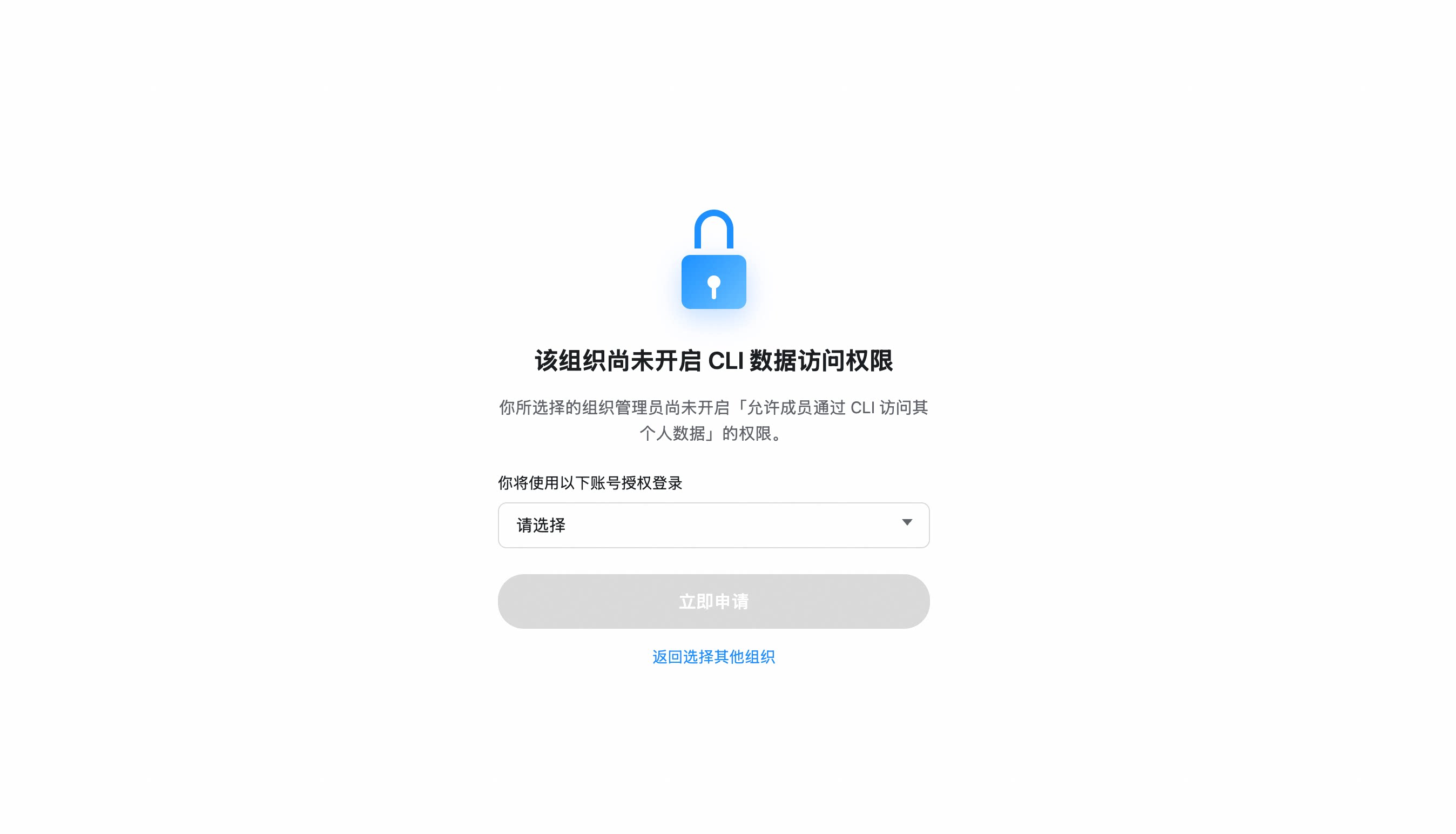
If your organization hasn't enabled CLI access, you'll be prompted to send an access request to your admin. Once approved, re-run
dws auth login.
Organization hasn't enabled CLI access?
- After selecting your organization, click "Apply Now" to notify the admin
- The admin receives a request card and can approve with one click
- Once approved, re-run
dws auth login
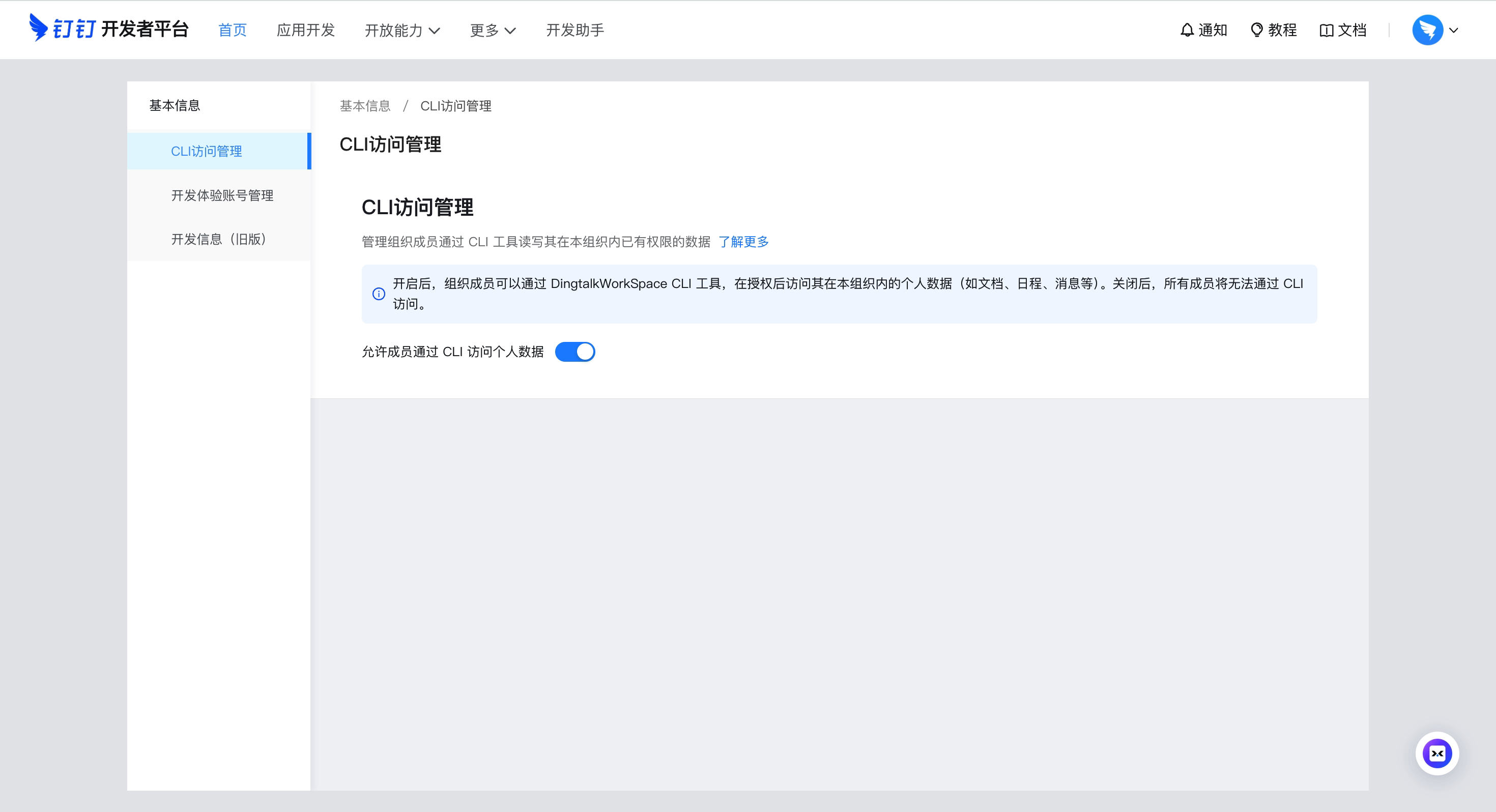
Admin: Enable CLI access for your organization
Go to Developer Platform → "CLI Access Management" → Enable.
Custom App mode (CI/CD, ISV integration)
For enterprise-managed scenarios, create your own DingTalk app:
- Open Platform Console → Create App
- Security Settings → Add redirect URLs:
http://127.0.0.1,https://login.dingtalk.com - Publish the app
- Login:
dws auth login --client-id <your-app-key> --client-secret <your-app-secret>Credentials are securely persisted after first login (Keychain). Subsequent runs auto-refresh tokens.
dws contact user search --keyword "engineering"     # search contacts
dws calendar event list                            # list calendar events
dws todo task create --title "Quarterly report" --executors "<your-userId>"   # create a todo (replace <your-userId>)
dws todo task list --dry-run # preview without executingdws is designed as an AI-native CLI. Complete Installation and Getting Started first, then configure your agent:
# Use --yes to skip confirmation prompts (required for agents)
dws todo task create --title "Review PR" --executors "<your-userId>" --yes

# Use --dry-run to preview operations (safe execution)
dws contact user search --keyword "engineering" --dry-run

# Use --jq to extract precisely (save tokens)
dws contact user get-self --jq '.result[0].orgEmployeeModel | {name: .orgUserName, dept: .depts[0].deptName, userId}'Agents don't need pre-built knowledge of every command. Use dws schema to dynamically discover capabilities:
# Step 1: Discover all available products
dws schema --jq '.products[] | {id, tool_count: (.tools | length)}'

# Step 2: Inspect target tool's parameter schema
dws schema aitable.query_records --jq '.tool.parameters'

# Step 3: Construct the correct call
dws aitable record query --base-id BASE_ID --table-id TABLE_ID --limit 10The repo ships a complete Agent Skill system (skills/). After installing, AI tools like Claude Code / Cursor can operate DingTalk directly through natural language:
# Install skills into current project
curl -fsSL https://raw.githubusercontent.com/DingTalk-Real-AI/dingtalk-workspace-cli/main/scripts/install-skills.sh | sh
install.shinstalls to$HOME/.agents/skills/dws(global);install-skills.shinstalls to./.agents/skills/dws(current project).
What's included:
| Component | Path | Description |
|---|---|---|
| Master Skill | SKILL.md |
Intent routing, decision tree, safety rules, error handling |
| Product references | references/products/*.md |
Per-product command reference (aitable, chat, calendar, etc.) |
| Intent guide | references/intent-guide.md |
Disambiguation for confusing scenarios (e.g. report vs todo) |
| Global reference | references/global-reference.md |
Auth, output formats, global flags |
| Error codes | references/error-codes.md |
Error codes + debugging workflows |
| Recovery guide | references/recovery-guide.md |
RECOVERY_EVENT_ID handling |
| Ready-made scripts | scripts/*.py |
13 batch operation scripts (see below) |
Ready-made scripts — 13 Python scripts for common multi-step workflows
| Script | Description |
|---|---|
calendar_schedule_meeting.py |
Create event + add participants + find & book available meeting room |
calendar_free_slot_finder.py |
Find common free slots across multiple people, recommend best meeting time |
calendar_today_agenda.py |
View today/tomorrow/this week's schedule |
import_records.py |
Batch import records from CSV/JSON into AITable |
bulk_add_fields.py |
Batch add fields to an AITable data table |
upload_attachment.py |
Upload attachment to AITable attachment field |
todo_batch_create.py |
Batch create todos from JSON (with priority, due date, executors) |
todo_daily_summary.py |
Summarize today/this week's incomplete todos |
todo_overdue_check.py |
Scan overdue todos and output overdue list |
contact_dept_members.py |
Search department by name and list all members |
attendance_my_record.py |
View my attendance records for today/this week/specific date |
attendance_team_shift.py |
Query team shift schedules and attendance statistics |
report_inbox_today.py |
View today's received reports with details |
ISV Integration: Author your own Agent Skills and orchestrate them with dws skills for cross-product workflows: ISV Skill → dws Skill → DingTalk Open Platform API (enforced auth + full audit).
Smart Input Correction — auto-corrects common AI model parameter mistakes
Built-in pipeline engine that normalizes flag names, splits sticky arguments, and fuzzy-matches typos:
# Naming convention auto-conversion (camelCase / snake_case / UPPER -> kebab-case)
dws aitable record query --baseId BASE_ID --tableId TABLE_ID         # auto-corrected to --base-id --table-id

# Sticky argument splitting
dws contact user search --keyword "engineering" --timeout30           # auto-split to --timeout 30

# Fuzzy flag name matching
dws aitable record query --base-id BASE_ID --tabel-id TABLE_ID       # --tabel-id -> --table-id

# Value normalization (boolean / number / date / enum)
# "yes" -> true, "1,000" -> 1000, "2024/03/29" -> "2024-03-29", "ACTIVE" -> "active"| Agent Output | dws Auto-Corrects To |
|---|---|
--userId |
--user-id |
--limit100 |
--limit 100 |
--tabel-id |
--table-id |
--USER-ID |
--user-id |
--user_name |
--user-name |
jq Filtering & Field Selection — fine-grained output control to reduce token consumption
# Built-in jq expressions
dws aitable record query --base-id BASE_ID --table-id TABLE_ID --jq '.invocation.params'
dws schema --jq '.products[] | {id, tools: (.tools | length)}'

# Return only specific fields
dws aitable record query --base-id BASE_ID --table-id TABLE_ID --fields invocation,response
Schema Introspection — query parameter schemas before making calls
dws schema                                              # list all products and tools
dws schema aitable.query_records                        # view parameter schema
dws schema aitable.query_records --jq '.tool.required'   # view required fields
dws schema --jq '.products[].id'                        # extract all product IDs
Pipe & File Input — read flag values from files or stdin
# Read message body from a file
dws chat message send-by-bot --robot-code BOT_CODE --group GROUP_ID \
  --title "Weekly Report" --text @report.md

# Pipe content via stdin
cat report.md | dws chat message send-by-bot --robot-code BOT_CODE --group GROUP_ID \
  --title "Weekly Report"

# Read from stdin explicitly
dws chat message send-by-bot --robot-code BOT_CODE --group GROUP_ID \
--title "Weekly Report" --text @-| Service | Command | Commands | Subcommands | Description |
|---|---|---|---|---|
| Contact | contact |
6 | user dept |
Search users by name/mobile, batch query, departments, current user profile |
| Chat | chat |
10 | message group search |
Group CRUD, member management, bot messaging, webhook |
| Bot | chat bot |
6 | bot group message search |
Robot creation/search, group/single messaging, webhook, message recall |
| Calendar | calendar |
13 | event room participant busy |
Events CRUD, meeting room booking, free-busy query, participant management |
| Todo | todo |
6 | task |
Create, list, update, done, get detail, delete |
| Approval | oa |
9 | approval |
Approve/reject/revoke, pending tasks, initiated instances, process list |
| Attendance | attendance |
4 | record shift summary rules |
Clock-in records, shift schedules, attendance summary, group rules |
| Ding | ding |
2 | message |
Send/recall DING messages |
| Report | report |
7 | create list detail template stats sent |
Create reports, sent/received list, templates, statistics |
| AITable | aitable |
20 | base table record field attachment template |
Full CRUD for bases/tables/records/fields, templates |
| Workbench | workbench |
2 | app |
Batch query app details |
| DevDoc | devdoc |
1 | article |
Search platform docs and error codes |
86 commands across 12 products. Run
dws --helpfor the full list, ordws <service> --helpfor subcommands.
Coming soon
doc (documents) · mail (email) · minutes (AI transcription) · drive (cloud drive) · conference (video) · tb (Teambition) · aiapp (AI apps) · live (streaming) · skill (marketplace)
dws treats security as a first-class architectural concern, not an afterthought. Credentials never touch disk, tokens never leave trusted domains, permissions never exceed grants, operations never escape audit — every API call must pass through DingTalk Open Platform's authentication and audit chain, no exceptions.
For Developers
| Mechanism | Details |
|---|---|
| Encrypted token storage | PBKDF2 + AES-256-GCM encryption, keyed by device physical MAC address; cross-platform Keychain/DPAPI integration provides additional protection — tokens cannot be decrypted on another machine |
| Input security | Path traversal protection (symlink resolution + working directory containment), CRLF injection blocking, Unicode visual spoofing filtering — prevents AI Agents from being tricked by malicious instructions |
| Domain allowlist | DWS_TRUSTED_DOMAINS defaults to *.dingtalk.com; bearer tokens are never sent to non-allowlisted domains |
| HTTPS enforced | All requests require TLS; HTTP only permitted for loopback during development |
| Dry-run preview | --dry-run shows call parameters without executing, preventing accidental mutations |
| Zero credential persistence | Client ID / Secret used in memory only — never written to config files or logs |
For Enterprise Admins
| Mechanism | Details |
|---|---|
| OAuth device-flow auth | Users must authenticate through an admin-authorized DingTalk application |
| Least-privilege scoping | CLI can only invoke APIs granted to the application — no privilege escalation |
| Allowlist gating | Admin confirmation required during co-creation phase; self-service approval planned |
| Full-chain audit | Every data read/write passes through the DingTalk Open Platform API — enterprise admins can trace complete call logs in real time; no anomalous operation can hide |
For ISVs
| Mechanism | Details |
|---|---|
| Tenant data isolation | Operates under authorized app identity; cross-tenant access is impossible |
| Skill sandbox | Agent Skills are Markdown documents (SKILL.md) — prompt descriptions only, no arbitrary code execution |
| Zero blind spots | Every API call during ISV–dws skill orchestration is forced through DingTalk Open Platform authentication — full call chain is traceable with no bypass path |
Found a vulnerability? Report via GitHub Security Advisories. See SECURITY.md.
- Reference — environment variables, exit codes, output formats, shell completion
- Architecture — discovery-driven pipeline, IR, transport layer
- Changelog — release history and migration notes
See CONTRIBUTING.md for build instructions, testing, and development workflow.
Apache-2.0